
Services
Hydro Vacuum Services
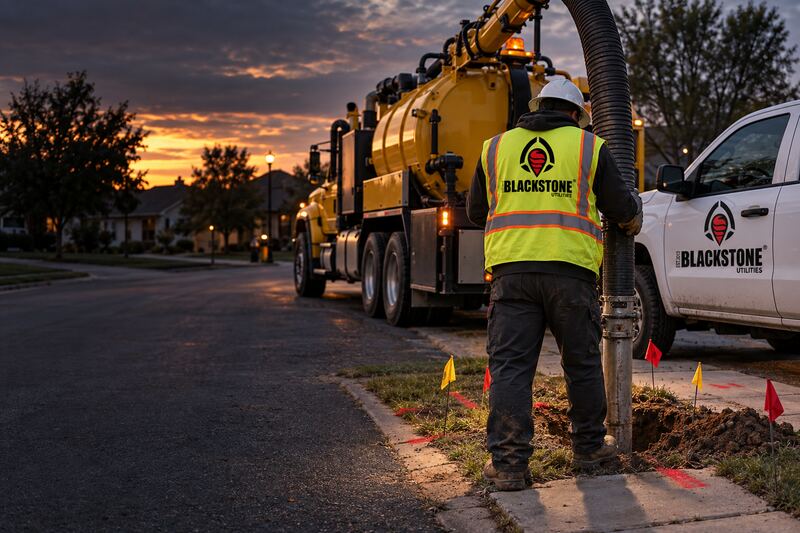
Hydro vacuum services dig with pressurized water and a vacuum instead of a bucket, so buried utilities are exposed without damage. Across the Midwest and Southeast, Blackstone Utilities provides vacuum excavation, potholing, slot trenching, daylighting of existing lines and removal of debris and spoil, around fiber, power, water and gas lines.
How does hydro vacuum excavation work?
A truck-mounted unit cuts the soil with pressurized water while a vacuum draws the slurry into a debris tank. The result is a clean, precise opening dug without a bucket or shovel, which is why it is the method used right next to live utilities.
What hydro vacuum work covers
Vacuum excavation
Hydro excavation, also called vacuum excavation, digs pits, trenches and openings to a set size and depth with water and vacuum. It suits tight spaces and any dig close to existing lines.
Potholing
Potholing exposes a buried utility at a single point so its position, depth and size can be confirmed before trenching or drilling nearby. On a fiber or power build, a pothole at each crossing shows the existing line before the drill passes.
Slot trenching
A slot trench is a narrow trench cut with water and vacuum across the path of planned work, to find every line that crosses it. It is also a way to place small conduit or cable close to other utilities without risking them.
Daylighting utilities
Daylighting exposes a buried line along a stretch, not just at one point, so it can be seen, measured and protected while work goes on beside it.
Debris and spoil removal
The same trucks remove spoil, mud and debris from excavations, and clear sediment and standing water from catch basins, pits, vaults and structures. The material decides how it is handled and where it can go, so tell us what it is when you request a quote.
What to send for a quote
- Where the work is: the address or nearest intersection.
- What needs to be exposed or removed, and roughly how many locations.
- The surface: pavement, lawn or open ground.
- What the material is, if it is not soil, and where it can go.
At a glance
- Service type
- Hydro vacuum services
- Work
- Vacuum excavation, potholing, slot trenching
- Service area
- The Midwest and Southeast
- How to start
- Call us or request a quote
How we do the work
-
01
Locate
We request 811 locates and mark existing utilities in the work area before digging.
-
02
Excavate
Pressurized water loosens the soil and the vacuum draws it into the truck's tank.
-
03
Expose
We expose, measure and protect the line, or open the slot for the new one.
-
04
Restore
We remove the spoil, backfill the hole and restore the surface to the project specifications.
Questions about hydro vacuum services
What is hydro excavation?
Hydro excavation, also called vacuum excavation, uses pressurized water to loosen soil and a vacuum to remove it, exposing buried utilities without a bucket or shovel. It digs pits, trenches and openings to a set size and depth, which suits tight spaces and any dig close to existing lines.
What is potholing?
Potholing is digging a small hole to expose a buried utility so its position and depth can be confirmed. Hydro excavation is a common way to do it. On a fiber or power build, a pothole at each crossing shows the existing line before the drill passes.
What is slot trenching?
A slot trench is a narrow trench dug with water and vacuum across the path of planned work. It finds every buried line that crosses the path before trenching or drilling starts. It is also a way to place small conduit or cable close to other utilities without risking them.
What does daylighting a utility mean?
Daylighting exposes a buried utility along a stretch, not just at one point, so it can be seen, measured and protected while work goes on beside it. Hydro vacuum excavation is the usual method because it does not damage the line.
Can you remove spoil and debris from an excavation?
Yes. The vacuum truck removes spoil, mud and debris from excavations, and clears sediment and standing water from catch basins, pits, vaults and structures. Tell us what the material is when you request a quote, so it can be handled and disposed of correctly.
What information do you need for a quote?
The location of the work, what needs to be exposed, a short description of the job and how to reach you. Mention any plans or dimensions in the description, and say whether the work is new or a repair. We follow up by phone or email.
Related services
We work across the Midwest and Southeast. See the service areas for the states and cities we serve.
Request a quote for hydro vacuum services
Send the location and the scope, and we will follow up. Office hours: Mon-Fri 7:00 AM-7:00 PM CT.